
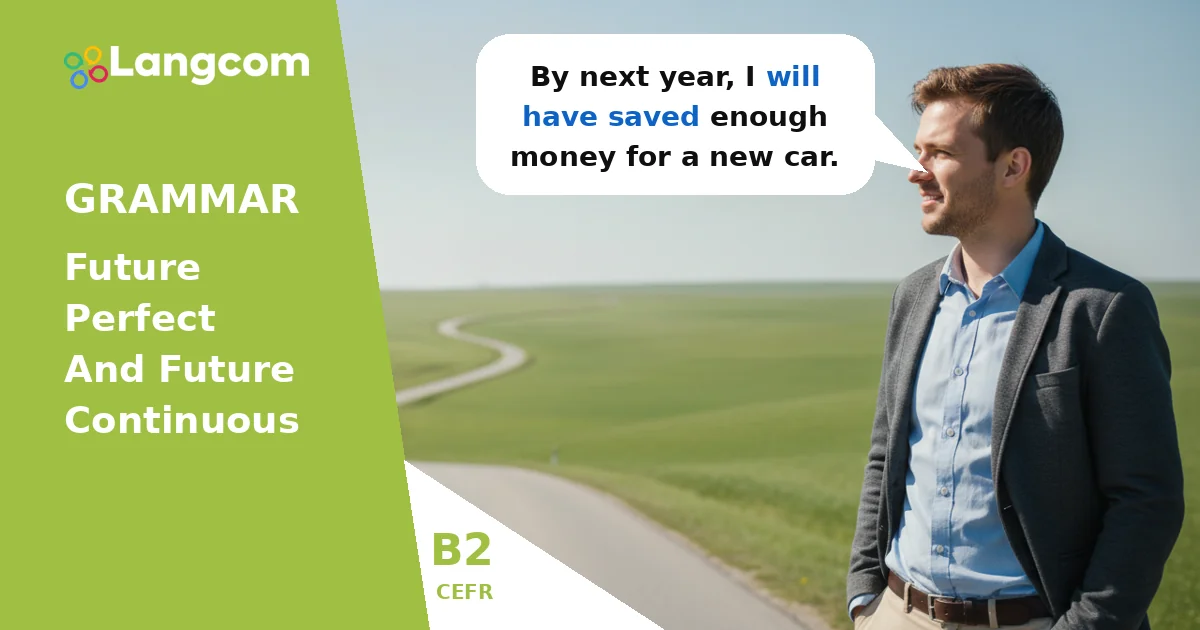

What is the Future Perfect Tense?
The Future Perfect tense is used to talk about an action that will be completed before a specific point in the future. Think of it as looking back from a future moment to see something already finished.
- We often use time expressions like by, by then, oder by the time with this tense. These phrases indicate the deadline for the action.
- The structure is will have + past participle (verb in -ed or third form).
This tense helps you set expectations for when something will be done.
✍️ Du bist dir nicht sicher, auf welchem Niveau du bist?
Machen Sie unseren kostenlosen Einstufungstest und erhalten Sie individuelles Feedback von zertifizierten Cambridge-Prüfern.
Machen Sie unseren KOSTENLOSEN EinstufungstestWhat is the Future Continuous Tense?
The Future Continuous tense describes an action that will be in progress at a specific time in the future. It shows that an action starts before, continues through, and possibly finishes after that future point.
- Common time expressions include at this time tomorrow, all day/week, oder while.
- The structure is will be + verb-ing (present participle).
You can also use the Future Continuous for planned future actions, especially when you are talking about routine or expected events.
How Are Future Perfect and Future Continuous Different?
The main difference lies in whether the action is completed or ongoing at a future point.
- Future Perfect: Focuses on completion. The action is finished *before* a future time.
- Future Continuous: Focuses on progress. The action is *happening at* a future time.
Consider the specific moment you are referring to in the future. Is the action done by then, or is it still happening?
| Future Perfect | Future Continuous | |
|---|---|---|
| Positive | Subject + will have + past participle I will have finished. |
Subject + will be + verb-ing I will be working. |
| Negative | Subject + will not (won’t) have + past participle She won’t have arrived. |
Subject + will not (won’t) be + verb-ing He won’t be sleeping. |
| Question | Will + subject + have + past participle? Will they have left? |
Will + subject + be + verb-ing? Will you be waiting? |
Beispiele
- By next year, I will have saved enough money for a new car.
- They will have finished the project before the deadline on Friday.
- When you arrive, I will be waiting for you at the airport.
- At 7 PM tonight, she will be studying for her exam.
- I will have eaten dinner by the time you call me.
- Don’t call me at 3 PM; I will be driving home.
- By the end of the month, we will have lived in this city for five years.
- This time next week, we will be relaxing on the beach.
Übung
Bist du bereit, dein Zertifikat zu erwerben?
Der Kurs Langcom bereitet die Teilnehmer auf die Prüfungen von Cambridge, IELTS, TOEFL, DELE, SIELE und Michigan vor.
Erste Schritte mit LangcomHäufige Fehler bei Spanischsprechern
Spanish speakers often make mistakes with these tenses due to direct translation or confusion with similar tenses in Spanish.
- Confusing Future Perfect with Simple Future: A common error is using the simple future when the action will be completed before another future point. For example, saying “By next year, I will save enough money” instead of the correct “By next year, I will have saved enough money.” The Future Perfect emphasizes completion before a deadline.
- Overusing Simple Future for Ongoing Actions: Sometimes, the simple future is used instead of Future Continuous for actions in progress. For instance, “At 7 PM, I will study” (simple future, implies starting at 7 PM) versus “At 7 PM, I will be studying” (Future Continuous, implies already in the process of studying at 7 PM). Remember, Future Continuous highlights the ongoing nature.
- Incorrectly using ‘by’ with Future Continuous: Das Wort by is almost always a signal for Future Perfect, indicating a completion deadline. Using it with Future Continuous, like “By 7 PM, I will be studying”, is incorrect. Instead, use “At 7 PM, I will be studying” oder “By 7 PM, I will have studied for two hours.”
Häufig gestellte Fragen
Can I use ‘going to’ with Future Perfect or Future Continuous?
Ja, du kannst going to statt will for both tenses, especially when talking about plans or predictions based on present evidence. For example, “By next year, I am going to have saved enough money” oder “At 7 PM, she is going to be studying.”
Are there situations where both tenses could be used?
Not usually for the same exact meaning. They describe different aspects of time. However, you might use them in related sentences. For example, “By 8 PM, I will have finished cooking dinner” (Future Perfect, completed) and “At 8 PM, we will be eating dinner” (Future Continuous, in progress).
What is the difference between Future Continuous and Present Continuous for future plans?
The Present Continuous (I am meeting) is for definite, pre-arranged plans, often with a specific time and place. The Future Continuous (I will be meeting) is for an action that will be in progress at a future time, or for a general prediction about what will be happening. It can also describe planned actions, but often with less emphasis on a fixed arrangement.



0 Kommentare