

What are common English words for food?
Learning words for food helps you talk about daily life. You can describe what you like or what you want to buy.
- We often group food words into categories like meat, fruit, and vegetables.
- Das Verb eat means to put food in your mouth and swallow it. For example, I eat breakfast every morning.
🎓 Englisch lernen mit der Blended-Methode
Kleingruppen · KI-Tutor rund um die Uhr · Vorbereitung auf die Cambridge-Prüfungen
Pläne von $39 $79 pro Monat
How do we talk about meat in English?
Meat is food from animals. Here are some common words for meat:
- Chicken: This is a very popular type of meat. I like to eat chicken for dinner.
- Steak: This is a thick slice of meat, usually from a cow. My father cooks steak on Saturdays.
- Lamb: This meat comes from a young sheep. Lamb is common in some countries.
What are some common fruits in English?
Fruits are sweet and healthy foods that grow on trees or plants. Here are some examples:
- Pears: These are sweet fruits, usually green or yellow. I bought three pears. (Singular: pear)
- Lemons: These are yellow, sour fruits often used in drinks or cooking. Lemons are very sour.
- Grapes: These are small, round fruits that grow in bunches. They can be green or purple. I love eating grapes.
What vegetables can we learn?
Vegetables are parts of plants that we eat. They are good for your health.
- Mushrooms: These are a type of fungus, often used in cooking. I put mushrooms in my soup.
- Beans: These are seeds from a plant, often cooked and eaten. We eat beans with rice. (Singular: bean)
- Carrots: These are orange root vegetables. Rabbits eat carrots.
- Onions: These are vegetables with a strong smell and taste, often used in many dishes. Onions make me cry when I cut them.
Singular and Plural Food Words
Some food words can be singular (one) or plural (more than one). It is important to use the correct form.
- For example, one fruit is a pear, but many are pears.
- One vegetable is a bean, but many are beans.
- Some words, like grapes, are almost always used in the plural form when talking about the fruit generally.
Beispiele
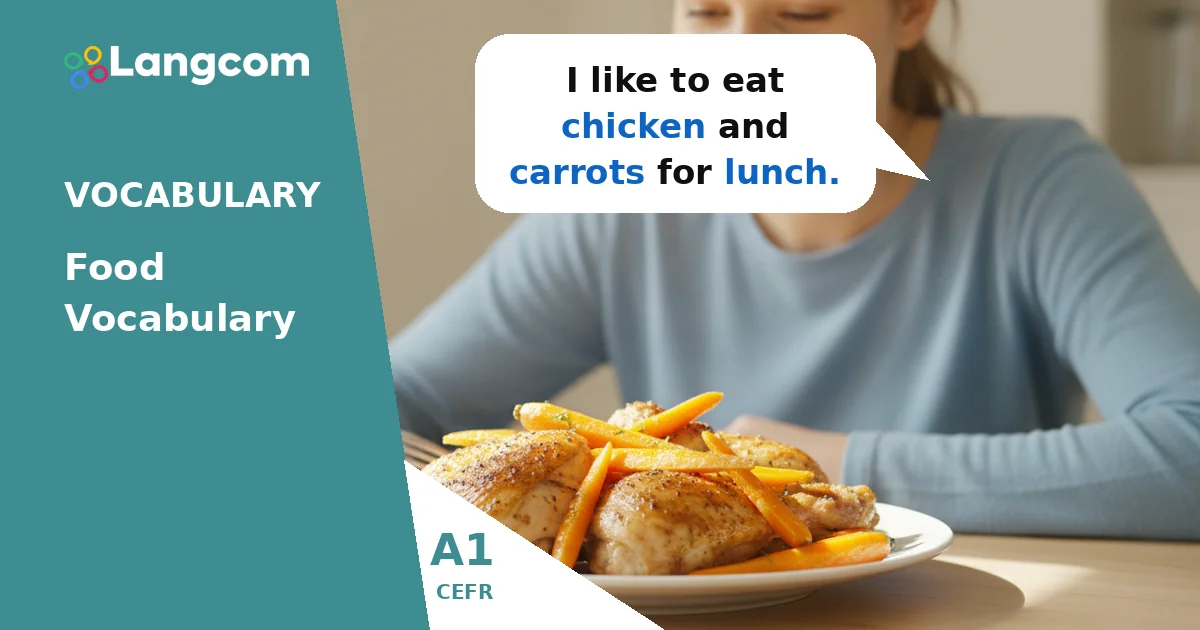
- I like to eat chicken and carrots for lunch.
- Do you want a pear or some grapes?
- My mother uses onions and mushrooms in her cooking.
- He ordered a steak with beans.
- Lemons are good for making lemonade.
Übung
💬 Benötigen Sie eine individuelle Beratung?
Als autorisiertes Cambridge-Vorbereitungszentrum können wir Ihnen helfen, den richtigen Kurs und die passende Zertifizierung zu finden. Chatten Sie noch heute mit unseren Beratern.
Chatten Sie mit einem Berater auf WhatsAppHäufige Fehler bei Spanischsprechern
Using 'the' with general food items
In Spanish, you often use 'el/la/los/las' when talking about food generally. In English, we usually don't.
- Falsch: I like the chicken. (If you mean chicken in general)
- Richtig: I like chicken.
- Richtig: I like the chicken you cooked yesterday. (If you mean specific chicken)
Confusing Singular and Plural
Remember to use plural for countable items when talking generally or about more than one.
- Falsch: I like pear.
- Richtig: I like pears.
- Falsch: I want bean. (If you mean more than one)
- Richtig: I want some beans.
Häufig gestellte Fragen
Why is learning food vocabulary important for A1 learners?
Learning food vocabulary helps you communicate in many daily situations. You can talk about what you like to eat, order food in a restaurant, or buy groceries at the market. It is a basic but essential part of English.
Are all food words singular in English?
No, many food words can be singular or plural. For example, one pear is singular, but two pears is plural. Some words like grapes are often used in the plural form.
How can I remember new food words?
Try to use new words in sentences. Label items in your kitchen, draw pictures, or make flashcards. Practice saying words like chicken, pears, und carrots aloud. The more you use them, the better you will remember them!



0 Kommentare