

How Do You Ask Someone’s Age in English?
To ask about age in English, you use a special question phrase.
- Start your question with How old…?
- After How old, you need a form of the verb to be (am, is, or are).
- Then, add the person or people you are asking about.
🎓 Impara l'inglese con il metodo misto
Piccoli gruppi · Tutor IA disponibile 24 ore su 24, 7 giorni su 7 · Preparazione agli esami di Cambridge
Piani da $39 $79 al mese
How Do You Say Your Age in English?
When you say your age, you also use the verb to be. This is very important!
- The basic structure is: Subject + to be (am/is/are) + number + (years old).
- The words years old are optional. You can say I am 25 oppure I am 25 years old. Both are correct.
- Remember to use the correct form of to be: I am, you are, he/she/it is, we are, they are.
What Numbers Are Important for Age?
To talk about age, you need to know numbers in English. For A1 level, focus on numbers up to 100.
- Here are some common numbers you will use:
- one, two, three, four, five, six, seven, eight, nine, ten
- eleven, twelve, thirteen, fourteen, fifteen, sixteen, seventeen, eighteen, nineteen
- twenty, thirty, forty, fifty, sixty, seventy, eighty, ninety, one hundred
| Numero | Word |
|---|---|
| 1 | one |
| 5 | five |
| 10 | ten |
| 15 | fifteen |
| 20 | twenty |
| 25 | twenty-five |
| 30 | thirty |
| 40 | forty |
| 50 | fifty |
| 60 | sixty |
| 70 | seventy |
| 80 | eighty |
| 90 | ninety |
| 100 | one hundred |
Esempi
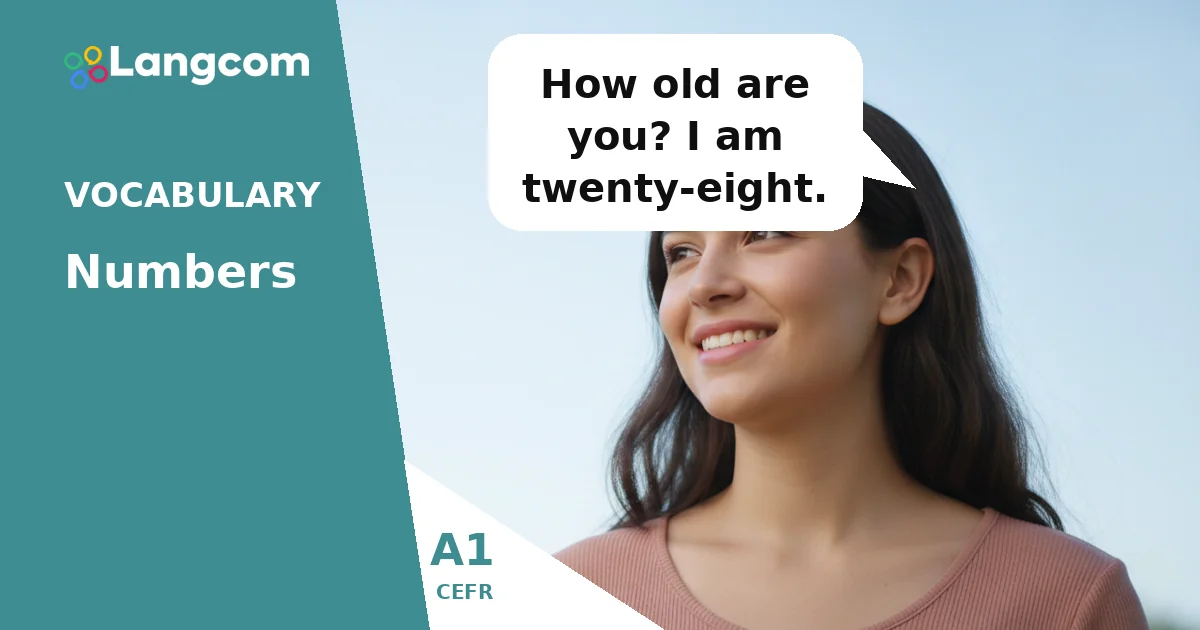
- How old are you? I am twenty-eight.
- How old is your sister? She is nineteen years old.
- How old are your parents? They are sixty and sixty-two.
- My brother is thirty-five.
- My grandmother is eighty-seven years old.
Esercitazione
💬 Hai bisogno di una consulenza personalizzata?
In qualità di Centro autorizzato di preparazione agli esami Cambridge, possiamo aiutarti a scegliere il corso e la certificazione più adatti alle tue esigenze. Contatta oggi stesso i nostri consulenti.
Chatta con un consulente su WhatsAppErrori comuni per chi parla spagnolo
A very common mistake for Spanish speakers is to use to have when talking about age. This is because in Spanish you say “tener… años” (to have… years). However, in English, we use to be.
- Errato: I have thirty years old.
- Corretto: I am thirty years old.
- Errato: How many years do you have?
- Corretto: How old are you?
Always remember to use to be (am, is, are) with age in English.
Domande frequenti
Is it “years old” or just “years”?
You can say I am twenty-five oppure I am twenty-five years old. Both are correct. You cannot say I am twenty-five years. The word old is important if you include years.
Why do I use “to be” and not “to have” for age?
In English, we describe age as a state of being, not something you possess. So, we use the verb to be (am, is, are). This is a key difference from Spanish, where you use “tener” (to have).
Do I need to know all the numbers?
For A1 level, focus on numbers up to 100, especially for common ages like 1-20 and then the tens (20, 30, 40, etc.). You will learn more numbers as you progress in English.

0 Commenti