

What is the difference between Lend and Borrow?
These two verbs are often confusing because they describe opposite actions with money or things.
- Lend means to give something to someone for a short time, expecting to get it back. The person who lends is the giver.
- Borrow means to take something from someone for a short time, with their permission, and intending to return it. The person who borrows is the receiver.
Think about the direction of the action. Money goes *from* the lender *to* the borrower.
🎓 Learn English with the Blended method
少人数制・24時間365日対応のAIチューター・ケンブリッジ試験対策
以下のプランから $39 $79 月額
How do we use the verb Lend?
当社では lend when you are the person giving the money or item.
- The pattern is usually lend + someone + something または lend + something + to + someone.
- You can lend money, a book, a car, or even your ear (to listen).
It's common to ask, Can you lend me...? or offer, I can lend you...
How do we use the verb Borrow?
当社では borrow when you are the person receiving the money or item.
- The pattern is usually borrow + something + from + someone.
- You borrow money, a pen, a tool, or even an idea.
It's common to ask, Can I borrow...? or say, I need to borrow...
What about Owe and Pay Back?
These two verbs are closely connected to lend そして borrow.
- Owe: This means you have a debt. You must return money or something to someone.
- The pattern is owe + someone + something または owe + something + to + someone.
- For example, if you borrowed £20, you owe £20 to the person who lent it.
- Pay back: This means to return the money you borrowed or owed.
- The pattern is pay + someone + back または pay back + something.
- It's the action of completing the debt.
| Action | Who does it? | 例 |
|---|---|---|
| Lend | The giver | I lent him £20. |
| Borrow | The receiver | I borrowed £20 from him. |
| Owe | The receiver (has a debt) | I owe him £20. |
| Pay back | The receiver (returns money) | I paid him back £20. |
例
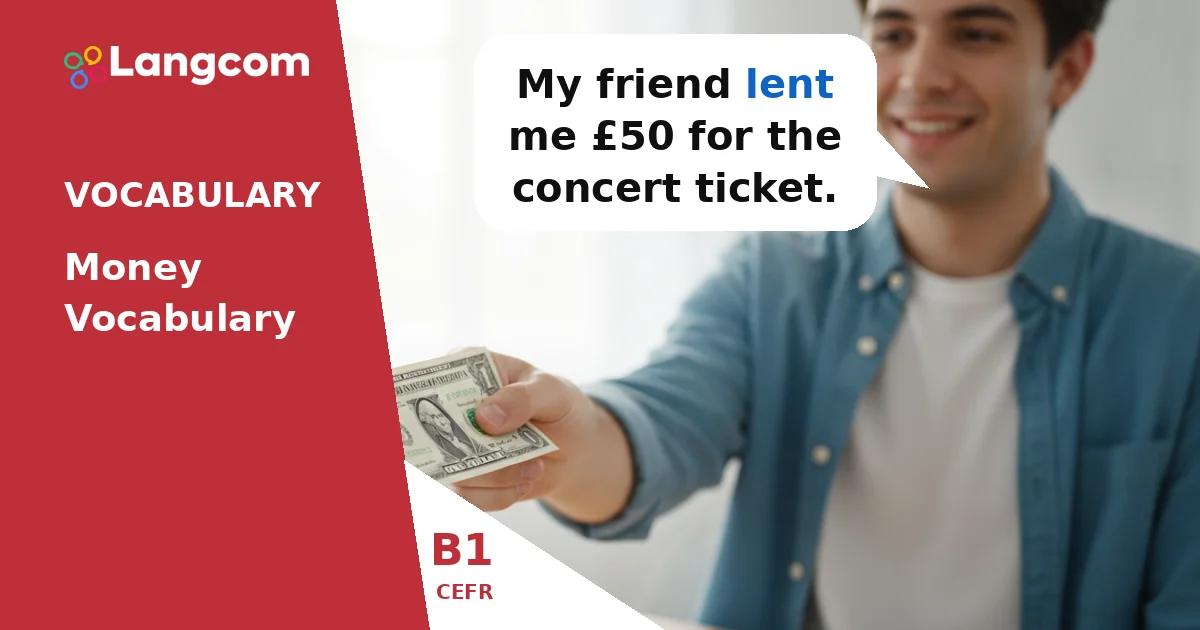
- My friend lent me £50 for the concert ticket.
- Could you lend me your umbrella? It's raining!
- The bank lends money to customers for houses and cars.
- I need to borrow some money for lunch today.
- She borrowed a book from the library.
- He borrowed his brother's car for the weekend.
- I owe you £15 for the cinema ticket.
- How much do I owe you?
- I will pay you back the money next week.
- Don't forget to pay back your loan on time.
練習
スペイン語話者がよく犯す間違い
Spanish speakers sometimes confuse lend そして borrow because the verb "prestar" in Spanish can mean both "to lend" and "to borrow" depending on the context.
- 誤り: Can I lend your pen? (You are asking to *take* the pen, so you should use borrow.)
- 正しい: Can I borrow your pen?
- 誤り: He borrowed me £20. (The person giving the money is the subject of lend.)
- 正しい: He lent me £20. (Or I borrowed £20 from him.)
Remember to think about who is giving and who is receiving.
よくある質問
Can I lend money from someone?
No, you borrow money from someone. You lend money to someone.
Is loan a verb or a noun?
Loan is usually a noun, meaning the money that is lent または borrowed. For example, I took out a loan. As a verb, loan is less common than lend in British English but is used in American English, meaning the same as lend.
What's the past tense of lend and borrow?
The past tense of lend は lent. The past tense of borrow は borrowed.
How is this vocabulary useful for B1 exams?
In B1 speaking or writing tasks, you might need to discuss personal finance, shopping, or making plans with friends. Using lend, borrow, owe, 、および pay back correctly shows good control of everyday English vocabulary.


コメント 0 件