

What are ‘Some’ and ‘Any’?
Some 和 any are quantifiers. They tell us about an unknown or unspecified amount or number of something.
We use them with both countable nouns (things we can count, like books) and uncountable nouns (things we cannot count, like sugar).
When Do We Use ‘Some’?
我们使用 some mainly in affirmative (positive) sentences.
- With countable nouns: I have some friends.
- With uncountable nouns: She needs some water.
We also use some in questions when we are offering something or making a request.
- For offers: Would you like some tea? (We expect the answer ‘yes’.)
- For requests: Can I have some help? (We expect help.)
When Do We Use ‘Any’?
我们使用 any mainly in negative sentences and most questions.
- In negative sentences (with not): I don’t have any brothers.
- In questions: Do you have any questions?
Sometimes, any can also be used in affirmative sentences when it means ‘it doesn’t matter which’.
- You can choose any book you like.
| <span data-no-translation>Some</span> | <span data-no-translation>Any</span> | |
|---|---|---|
| Affirmative Sentences | Yes (I have some ideas.) | No (unless it means ‘it doesn’t matter which’) |
| Negative Sentences | No | Yes (I don’t have any ideas.) |
| Questions (General) | No | Yes (Do you have any ideas?) |
| Questions (Offers/Requests) | Yes (Would you like some coffee?) | No |
示例
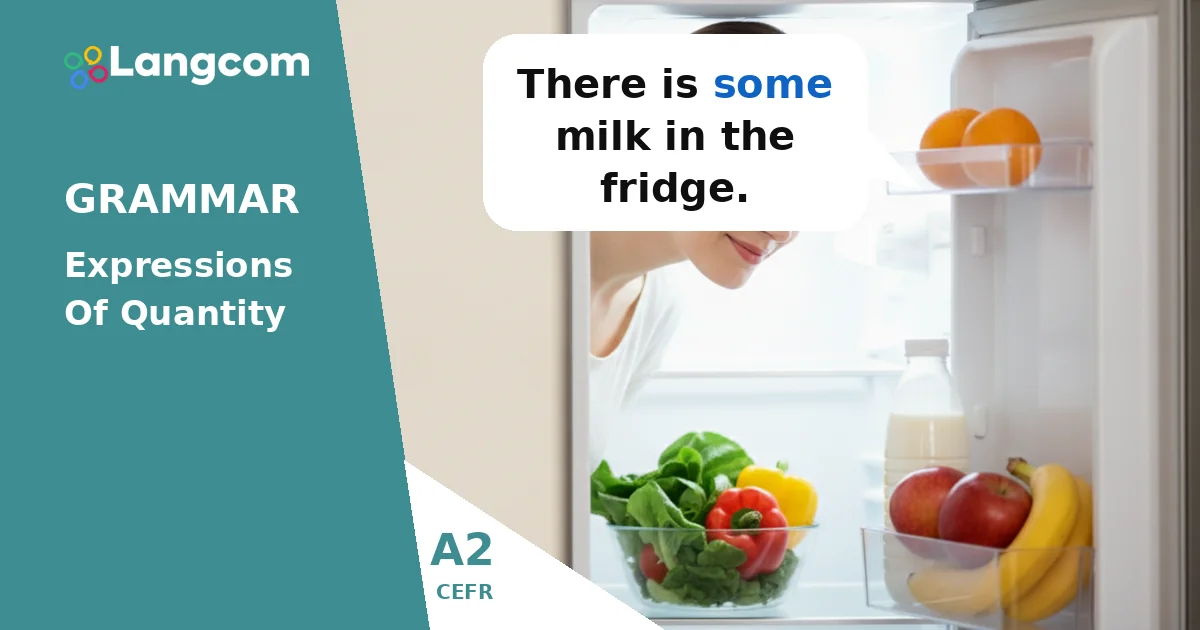
- There is some milk in the fridge.
- I bought some new clothes yesterday.
- Would you like some cake?
- Can I borrow some money?
- I don’t have any pets.
- She didn’t eat any food.
- Is there any sugar left?
- Do you have any plans for the weekend?
练习
Ready to earn your certificate?
Langcom prepares students for Cambridge, IELTS, TOEFL, DELE, SIELE and Michigan exams.
Get started with Langcom西班牙语母语者常犯的错误
Spanish speakers sometimes make mistakes with some 和 any because of differences in sentence structure.
- Using some in negative sentences:
Incorrect: I don’t have some money.
Correct: I don’t have any money. - Using any in affirmative sentences (unless it means ‘it doesn’t matter which’):
Incorrect: I have any friends.
Correct: I have some friends. - Double negatives: In Spanish, double negatives are common. In English, we usually avoid them.
Incorrect: I don’t have no money.
Correct: I don’t have any money. (Or I have no money.)
常见问题
Can I use ‘some’ with countable nouns?
Yes, you can use some with both countable nouns (e.g., some apples) and uncountable nouns (e.g., some water) in affirmative sentences.
When do I use ‘some’ in a question?
You use some in questions when you are offering something (Would you like some coffee?) or making a request (Can I have some bread?). You expect a positive answer.
Is ‘any’ always used in questions?
Mostly, yes. Any is used in general questions where you don’t know the answer (Do you have any siblings?). Remember the exceptions for offers and requests with some.
How important are ‘some’ and ‘any’ for the A2 Key exam?
Understanding some 和 any is very important for the A2 Key exam. You will need to use them correctly in writing tasks and speaking parts to show your ability to talk about quantities clearly.


0 条评论