
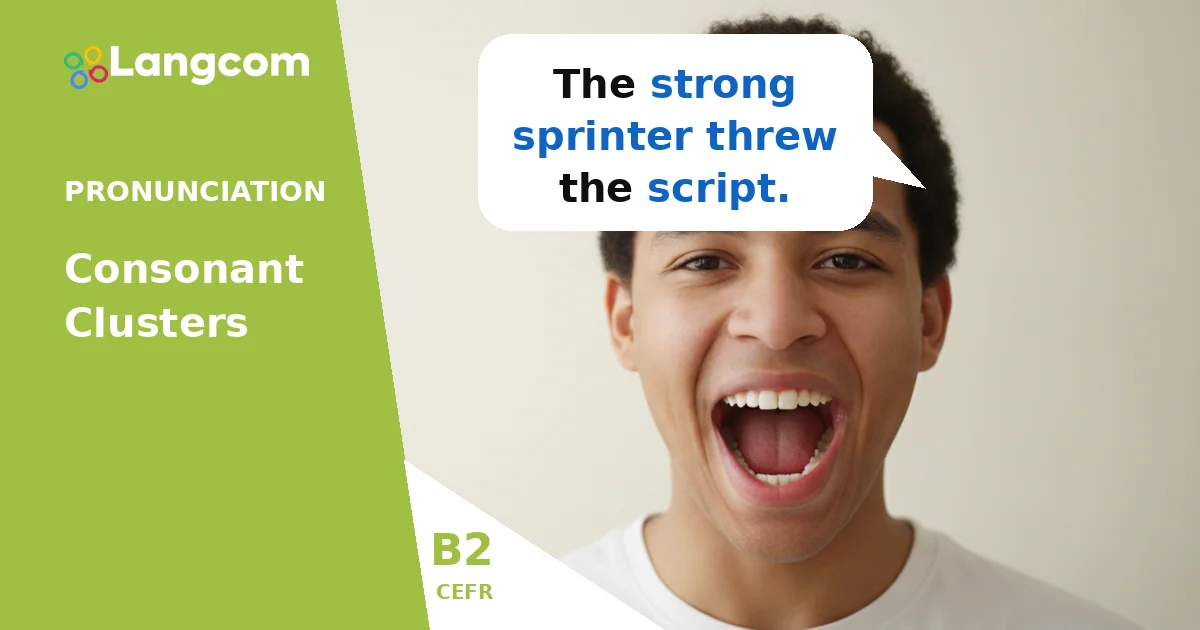

What Are Consonant Clusters?
A consonant cluster, also known as a consonant blend, is a sequence of two or more consonant sounds. These sounds are pronounced together, one after the other, within the same syllable.
- For example, in the word strong, the /str/ is a three-consonant cluster.
- In desk, /sk/ is a two-consonant cluster at the end.
- It’s important that each consonant sound in the cluster is clearly audible.
✍️ لست متأكدًا من مستواك؟
خُذ اختبار تحديد المستوى المجاني الخاص بنا واحصل على تعليقات مخصصة من ممتحنين معتمدين من كامبريدج.
قم بإجراء اختبار تحديد المستوى المجانيWhy Are Consonant Clusters Important for B2 Learners?
For B2 learners, accurate pronunciation of consonant clusters significantly impacts intelligibility and fluency.
- Clear Communication: Mispronouncing or simplifying clusters can make your words sound unclear or even change their meaning. For instance, tree مقابل. three.
- Natural Speech: Native English speakers use clusters constantly. Practicing them helps you sound more natural and confident.
- Listening Comprehension: Recognizing clusters when others speak will also improve your ability to understand spoken English, especially at faster speeds.
Types of Consonant Clusters and Examples
Consonant clusters can appear in different positions within English words:
- Initial Clusters (at the beginning of a word):
– Two consonants: bl (as in blue), gr (as in green), sp (as in speak)
– Three consonants: scr (as in scream), spl (as in splash), str (as in street) - Medial Clusters (in the middle of a word):
– These often occur across syllable boundaries or within a syllable. For example, expl (as in explain), compl (as in complete), instr (as in instrument) - Final Clusters (at the end of a word):
– Two consonants: ct (as in act), nd (as in hand), mp (as in jump)
– Three consonants: sts (as in tests), mpts (as in attempts), ngs (as in songs)
Tips for Practicing Consonant Clusters
- Listen Carefully: Pay close attention to how native speakers pronounce words with clusters. Use online dictionaries with audio.
- Slow Down: When you first practice, say the words very slowly, making sure to articulate each consonant sound distinctly. Gradually increase your speed.
- Focus on Articulation: Be aware of your tongue, teeth, and lip positions for each sound in the cluster. For example, for thr-, your tongue should be between your teeth.
- Record Yourself: Use your phone to record your speech and compare it to a native speaker’s pronunciation. This helps you identify areas for improvement.
- Minimal Pairs: Practice words that differ only by a cluster, like sip مقابل. strip أو pot مقابل. spot.
| Cluster Type | أمثلة |
|---|---|
| Initial (2 Consonants) | bl (blue), fr (friend), gl (glass), pl (place), sm (small), sn (snow), sp (speak), st (stop), sw (swim), tr (tree) |
| Initial (3 Consonants) | scr (scream), spl (splash), spr (spring), str (street), thr (three) |
| Medial | expl (explain), instr (instrument), compl (complete), constr (construct) |
| Final (2 Consonants) | ct (act), ft (left), ld (cold), lk (milk), mp (jump), nd (hand), nk (think), nt (want), pt (slept), sk (desk), sp (grasp), st (first) |
| Final (3+ Consonants) | cts (facts), lpts (sculpts), mpts (attempts), nds (hands), nks (thanks), nts (wants), sts (tests), xts (texts) |
أمثلة
- The strong sprinter threw the script.
- She explained the complex instructions.
- He asked for the twelfth list of tests.
- The splendid three screens blasted music.
- I promptly attempted the task.
التدريب
هل أنت مستعد للحصول على شهادتك؟
يُعد برنامج Langcom الطلاب لامتحانات كامبريدج وIELTS وTOEFL وDELE وSIELE وMichigan.
ابدأ مع Langcomالأخطاء الشائعة لدى المتحدثين باللغة الإسبانية
Spanish speakers often face specific challenges with English consonant clusters:
- Adding a Vowel Sound: A common mistake is to add an ‘e’ sound before initial ‘s’ clusters. For example, saying eschool بدلاً من school, ، أو estreet بدلاً من street. Remember, English clusters like sp-, st-, sk- start directly with the ‘s’ sound.
- Simplifying Final Clusters: English often has complex final clusters that are less common in Spanish. Learners might drop one or more sounds, for example, saying firs بدلاً من first, ، أو des بدلاً من desk. Ensure you pronounce all sounds, even if it feels difficult at first.
- Confusing Similar Sounds: Distinguishing between sounds like /b/ و /v/, ، أو /s/ و /z/ within clusters can be tricky. Practice minimal pairs like grab مقابل. grav (though grav isn’t a word, it helps isolate the sound).
الأسئلة الشائعة
What is the difference between a consonant cluster and a digraph?
A consonant cluster is a group of two or more consonant letters that represent separate sounds, like bl في blue (you hear both /b/ و /l/). A digraph is two consonant letters that represent a single sound, like sh في ship (you hear only one /ʃ/ sound).
Are all consonant clusters pronounced the same way?
No, the pronunciation of consonant clusters can vary slightly depending on the surrounding sounds or regional accents. However, the core sounds within the cluster remain distinct. For example, the str في street will always have distinct /s/, /t/, ، و /r/ sounds.
How can I improve my pronunciation of difficult clusters like ‘th’ or ‘sch’?
For tricky clusters, focus on the individual sounds first. For th, practice the /θ/ أو /ð/ sound in isolation. For sch (as in schedule), break it down into /sk/ و /ɛ/ أو /juː/. Then, slowly combine them. Listen to native speakers and imitate their mouth movements if possible.
Do consonant clusters affect word stress?
While consonant clusters themselves don’t directly determine word stress, they can make a syllable heavier, which might influence stress patterns in longer words. For B2 learners, focusing on correctly pronouncing the cluster itself is more important than linking it to stress rules, which are more complex.


0 تعليق