

What are common landforms in English?
Landforms are natural features of the Earth’s surface. Let’s learn some important ones.
- Mountain: A very tall natural high place on Earth.
- Mount Everest is the highest mountain in the world.
- Desert: A very dry area of land, often covered with sand.
- The Sahara Desert is very hot.
- Forest: A large area of land covered with many trees.
- Many animals live in the forest.
- Rainforest: A very dense forest in tropical areas that receives a lot of rain.
- The Amazon rainforest is home to many unique plants.
- Glacier: A large mass of ice that moves slowly over land.
- Glaciers can be found in cold places like the Arctic.
- Island: A piece of land completely surrounded by water.
- Hawaii is a beautiful island.
- Beach: A sandy or pebbly shore by the sea or a lake.
- We like to relax on the beach in summer.
🎓 Englisch lernen mit der Blended-Methode
Kleingruppen · KI-Tutor rund um die Uhr · Vorbereitung auf die Cambridge-Prüfungen
Pläne von $39 $79 pro Monat
What are common water features in English?
Water features are natural formations related to water.
- River: A large natural stream of water flowing in a channel to the sea, a lake, or another river.
- The Nile River is very long.
- Lake: A large body of still water surrounded by land.
- We went fishing in the lake.
- Waterfall: A place where a stream or river falls from a high place.
- Niagara Falls is a famous waterfall.
| Englisches Wort | Bedeutung |
|---|---|
| Desert | A very dry area of land, often with sand. |
| Forest | A large area of land covered with many trees. |
| River | A natural stream of water flowing to the sea or a lake. |
| Island | A piece of land completely surrounded by water. |
| Lake | A large body of still water surrounded by land. |
| Beach | A sandy or pebbly shore next to the sea or a lake. |
| Mountain | A very tall natural high place on Earth. |
| Glacier | A large mass of ice that moves slowly over land. |
| Rainforest | A very wet forest in tropical areas. |
| Waterfall | A place where a river or stream falls from a high place. |
Beispiele
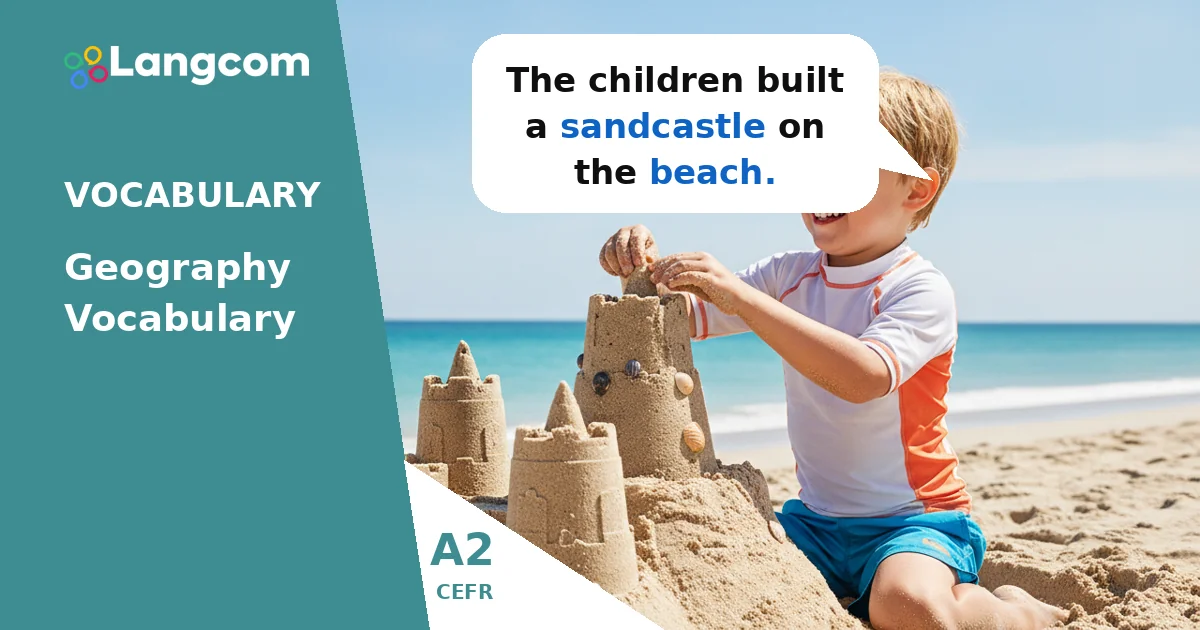
- The children built a sandcastle on the beach.
- You can see many tall mountains from here.
- The river flows into the big lake.
- It is very hot in the desert during the day.
Übung
💬 Benötigen Sie eine individuelle Beratung?
Als autorisiertes Cambridge-Vorbereitungszentrum können wir Ihnen helfen, den richtigen Kurs und die passende Zertifizierung zu finden. Chatten Sie noch heute mit unseren Beratern.
Chatten Sie mit einem Berater auf WhatsAppHäufige Fehler bei Spanischsprechern
Desert vs. Dessert
These two words sound similar but have different meanings and spellings:
- Desert (pronounced des-ert) means a dry, sandy place. I visited the desert.
- Dessert (pronounced dess-ert) means a sweet food eaten after dinner. I ate a delicious dessert.
Forest vs. Rainforest
Remember that a rainforest is a specific type of forest:
- A forest has many trees.
- A rainforest is a forest that receives a lot of rain and has a very rich variety of plants and animals, usually in tropical areas.
Silent ‘s’ in Island
Many learners try to pronounce the ‘s’ in island, but it is silent. Say /ˈaɪlənd/, nicht IS-land.
Häufig gestellte Fragen
Why is geography vocabulary important for A2 learners?
Learning words like mountain und river helps you describe places, understand travel information, and talk about nature in simple English. It makes your conversations about the world much clearer.
What is the difference between a lake and a river?
A lake is a large body of still water surrounded by land. A river is a natural stream of water that moves and flows towards the sea or another lake.
How can I remember these new words?
Try to connect new words like glacier oder waterfall with pictures. You can also use them in simple sentences about places you know or want to visit. Practice helps a lot!
Is the ‘s’ in island pronounced?
No, the ‘s’ in island is silent. You pronounce it like /ˈaɪlənd/.




0 Kommentare