

What are Comparative Adjectives?
Comparative adjectives are special words. They help us show differences between two nouns (people, places, things, or ideas).
We use them when we want to say that one thing has a certain quality more or less than another.
🎓 Learn English with the Blended method
Small groups · 24/7 AI Tutor · Cambridge preparation
Plans from $39 $79 per month
How Do We Form Comparative Adjectives?
The way we form comparative adjectives depends on the original adjective’s length.
-
For most short adjectives (one syllable):
We add -er to the end.
-
For adjectives ending in -e (one syllable):
We add -r to the end.
-
For adjectives ending in a consonant + vowel + consonant (one syllable):
We double the last consonant and add -er.
-
For adjectives ending in -y (two syllables):
We change -y to -i and add -er.
-
For most longer adjectives (two or more syllables):
We put the word more before the adjective.
Don’t Forget ‘Than’!
After the comparative adjective, we almost always use the word than. This word connects the two things you are comparing.
For example, you say My house is bigger than your house.
Irregular Comparative Adjectives
Some adjectives do not follow the normal rules. You need to learn these special forms.
- good becomes better
- bad becomes worse
- far becomes farther or further
| Adjective Type | Rule | Example |
|---|---|---|
| One-syllable | Add -er | old > older |
| One-syllable, ends in -e | Add -r | large > larger |
| One-syllable, CVC | Double last consonant + -er | big > bigger |
| Two syllables, ends in -y | Change -y to -i + -er | happy > happier |
| Two or more syllables | Use ‘more’ before the adjective | beautiful > more beautiful |
| Irregular | Special forms | good > better, bad > worse |
Examples
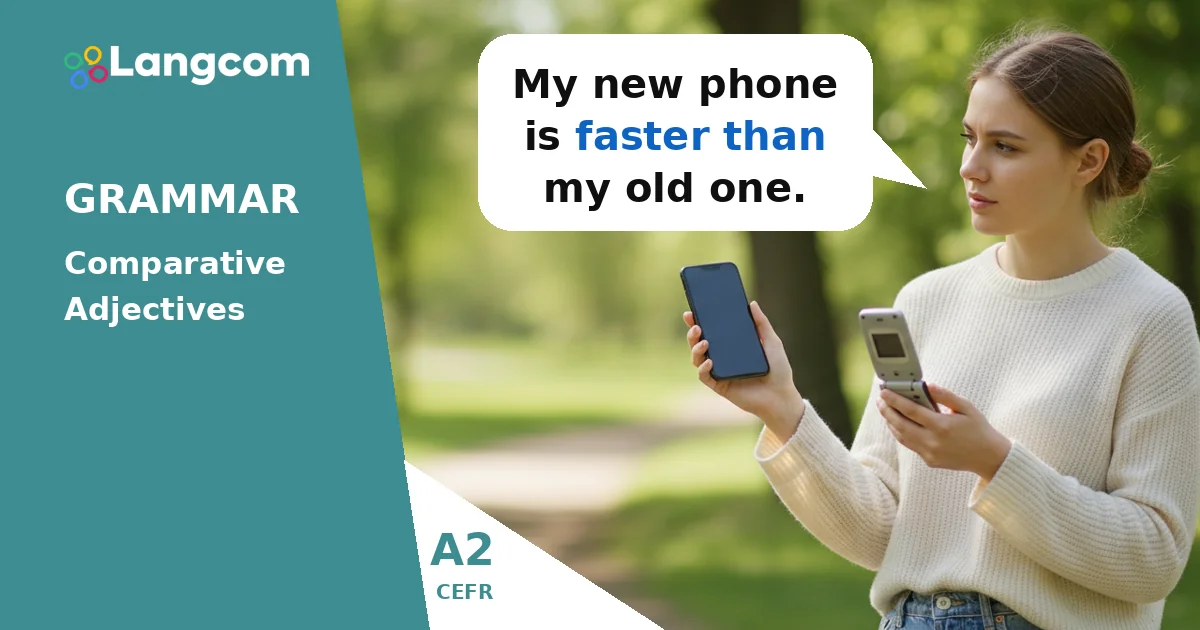
- My new phone is faster than my old one.
- This city is bigger than my hometown.
- Learning English is more interesting than watching TV.
- She is happier today than yesterday.
- The red car is more expensive than the blue car.
- Summer is hotter than winter.
- My brother is taller than me.
- This exercise is more difficult than the last one.
Practice
💬 Need personalized guidance?
As an Authorized Cambridge Preparation Centre, we can guide you to the right course and certification. Chat with our advisors today.
Chat with an Advisor on WhatsAppCommon mistakes for Spanish speakers
Many Spanish speakers make these common mistakes:
-
Using more with short adjectives:
Incorrect: This book is more short than that one.
Correct: This book is shorter than that one. -
Forgetting than:
Incorrect: My car is faster your car.
Correct: My car is faster than your car. -
Incorrect irregular forms:
Incorrect: This food is more good.
Correct: This food is better.
Frequently asked questions
When do I use comparative adjectives?
You use comparative adjectives when you want to compare two specific things, people, or ideas and show how one is different from the other. For example, My coffee is hotter than your tea.
What is the difference between ‘farther’ and ‘further’?
Both farther and further are comparative forms of far. Farther usually refers to physical distance (e.g., The store is farther away.). Further can refer to physical distance but also to abstract ideas or additional information (e.g., I need further details.).
Can I use ‘less’ instead of ‘more’?
Yes, you can use less with adjectives to show that something has a smaller amount of a quality. For example, This task is less difficult than the last one. We use less with all adjectives, regardless of length, and it is always followed by than.

0 Comments