

Who is in Your Immediate Family?
Your immediate family includes your closest relatives. These are the people you usually live with or see very often.
- Your mother is your female parent. Her name is Maria.
- Your father is your male parent. My father likes to read.
- Your parents are your mother y father together. My parents are very kind.
- A son is a male child. They have one son.
- A daughter is a female child. She is their daughter.
- Your children are your sons y daughters. I have two children.
- A brother is a male sibling. Do you have a brother?
- A sister is a female sibling. My sister is older than me.
🎓 Aprende inglés con el método mixto
Grupos reducidos · Tutor de IA disponible las 24 horas del día, los 7 días de la semana · Preparación para los exámenes de Cambridge
Planes de $39 $79 al mes
What About Your Parents’ Spouses?
These words describe people who are married.
- A husband is a married man. He is her husband.
- A wife is a married woman. My wife works in a hospital.
How Do We Talk About Extended Family?
Extended family includes other relatives, like your parents’ parents or your parents’ siblings.
- Your grandfather es tu mother’s father or your father’s father. My grandfather is 80 years old.
- Your grandmother es tu mother’s mother or your father’s mother. My grandmother loves to cook.
- Your grandparents are your grandfathers y grandmothers. I visit my grandparents every Sunday.
- Un aunt es tu mother’s sister or your father’s sister. My aunt lives in another city.
- Un uncle es tu mother’s brother or your father’s brother. My uncle is a doctor.
- A cousin is the child of your aunt o uncle. I have many cousins.
How to Ask About Family?
You can use simple questions to ask about someone’s family.
- To ask about siblings: Do you have any brothers or sisters?
- To ask about parents: Are your parents well?
- To ask about children: Do you have any children?
- To ask about a spouse: Is your husband/wife here?
| Family Member | Relationship |
|---|---|
| Mother | Female parent |
| Father | Male parent |
| Parents | Mother and father |
| Son | Male child |
| Daughter | Female child |
| Children | Sons and daughters |
| Brother | Male sibling |
| Sister | Female sibling |
| Husband | Married man |
| Wife | Married woman |
| Grandfather | Parent’s father |
| Grandmother | Parent’s mother |
| Grandparents | Grandfather and grandmother |
| Aunt | Parent’s sister |
| Uncle | Parent’s brother |
| Cousin | Child of an aunt or uncle |
Ejemplos
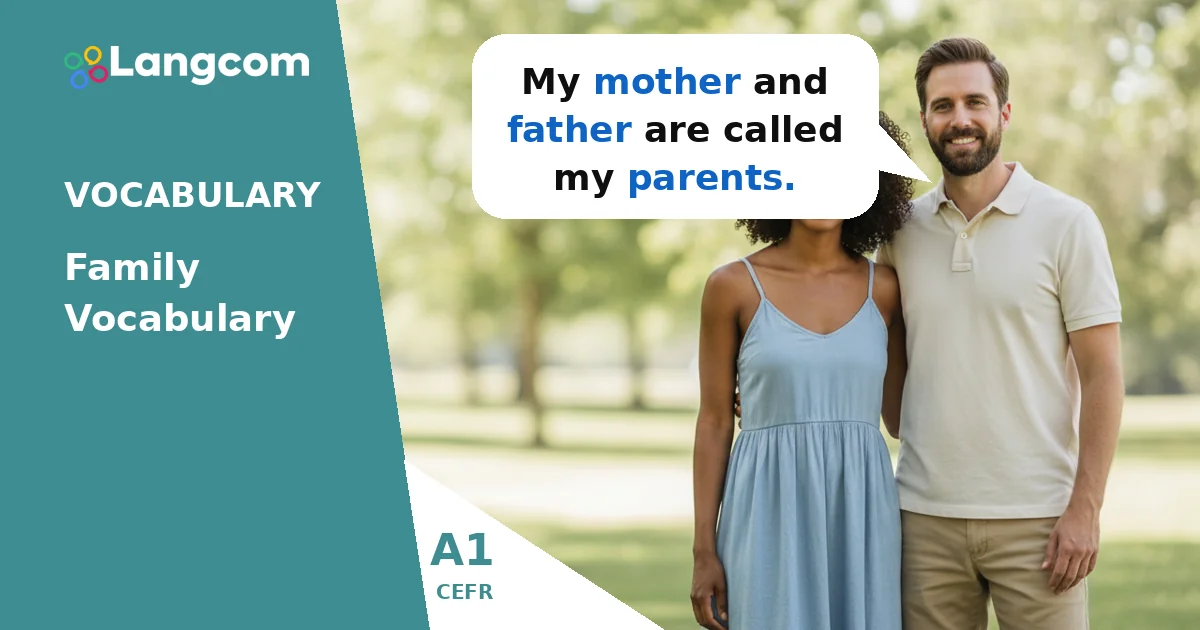
- My mother and father are called my parents.
- I have one brother and one sister.
- She has two children: a son and a daughter.
- My aunt and uncle are coming to visit.
- He is my cousin, the son of my father’s sister.
- My grandparents live in a big house.
- Her husband is very tall.
- My wife and I like to travel.
Práctica
💬 ¿Necesitas asesoramiento personalizado?
Como centro autorizado de preparación para los exámenes de Cambridge, podemos orientarte para que elijas el curso y la certificación más adecuados. Habla hoy mismo con nuestros asesores.
Chatea con un asesor por WhatsAppErrores habituales de los hispanohablantes
Errores habituales de los hispanohablantes
- Confusing ‘Parents’ and ‘Relatives’: In Spanish, ‘parientes’ means ‘relatives’. But in English, parents only means mother y father. Do not say My parents are my aunt and uncle. Say My relatives are my aunt and uncle.
- Using ‘Child’ for Adults: In Spanish, ‘hijo/a’ can refer to an adult son or daughter. In English, child usually refers to a young person. For adults, use son o daughter. Do not say My child is 30 years old. Say My son/daughter is 30 years old.
- Gender for ‘Cousin’: In Spanish, ‘primo/prima’ changes for gender. In English, cousin is used for both male and female. Do not say He is my male cousin. Just say He is my cousin.
Preguntas más frecuentes
What is the difference between ‘mother’ and ‘mom’?
Mother is the formal word. Mom is informal and common in everyday speech, especially in American English. Both mean the same person.
How do I say ‘my parents’ in English?
You say my parents. This word refers to both your mother and your father.
Can ‘children’ mean adult sons and daughters?
No, children usually means young people. For adult sons and daughters, use sons y daughters, o adult children if you need to specify.
What is a ‘sibling’?
A sibling is a formal word for a brother or a sister. You can say I have two siblings instead of I have one brother and one sister.

0 Comentarios